What stands out in Zettlr
The interesting part of Zettlr happens after you change your mind about a paragraph. A citation key can travel with its sentence as you move text around a Markdown document. When you export with citations enabled, the bibliography can follow the sources you actually cite. That is particularly handy for a community newsletter, where a short paragraph might be cut on deadline and nobody wants to reconcile the reference list by hand.
Windows, macOS and Linux. The packet includes two fictional source records and a ready-to-export Markdown brief.
Walkthrough
- Extract the practice folder and open brief.md in Zettlr. Read the file-specific bibliography setting at the top of the document. Open the adjacent park-maps.bib in a text editor to compare the two record keys with those in your draft.
- Under a working heading, write one factual sentence per source. Add a citation immediately after the claim. If your key is riverplan, the notation [@riverplan, p. 12] points to a particular page. Replace this invented key and locator with the ones from your own material.
- Split a complicated sentence whenever the sources support different parts of it. If a plan proposes an action and meeting minutes record its approval, cite the plan after the proposal and the minutes after the decision. A single citation at the end leaves the chronology ambiguous.
- End the document with a References heading and export with citation processing enabled. Open the resulting document. Check that both keys resolved, the page locator survived, and the two works appear under the heading. Remove one source’s only citation in a copy and repeat the export to check what changes.
Keep the practice library inside the packet
Extract the complete ZIP before opening brief.md. Its YAML header sets bibliography: ./park-maps.bib. The dot means the folder containing the brief. Keep the bibliography next to the Markdown file when moving the exercise to another computer. This file-specific setting lets you try two fictional sources while keeping your regular research library in place.
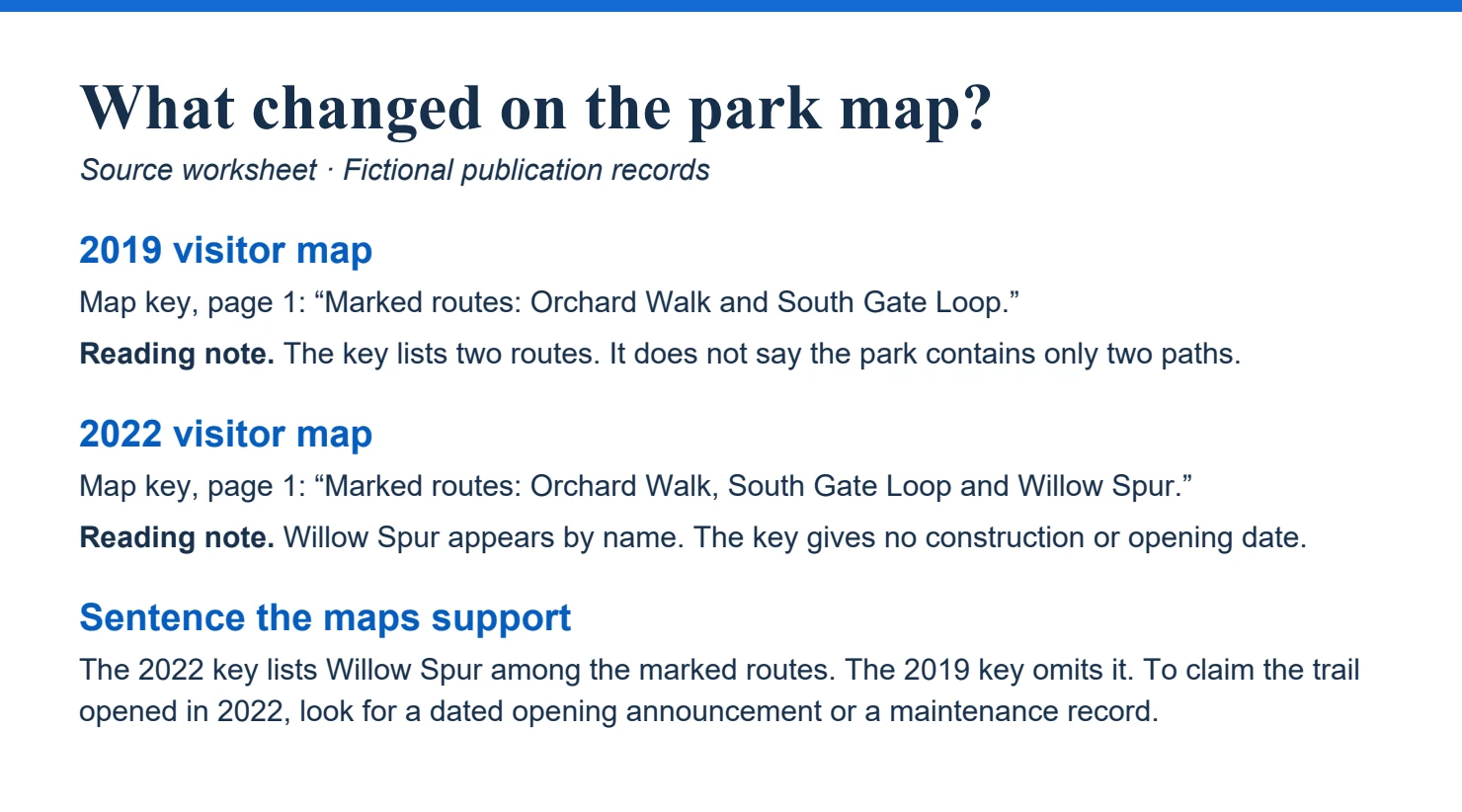
Open the bibliography sidebar. Compare the two source years against reading-notes.md. Both records have the same issuing body and title, so matching the title alone is an unreliable check. Match the 2019 map to alder2019 and the 2022 edition to alder2022. Page 1 is the printed map key in each case.
Run the one-sentence deletion test
Export brief.md with citation processing enabled and open the exported file. Check for a rendered citation at each claim and both years under References. Then open brief-after-cut.md from the packet. It removes the sentence supported by the 2019 map and preserves the citation beside the 2022 claim. Export to a different filename. Our source-file check found two distinct cited keys before the edit and one afterward. The expected second bibliography contains only the 2022 map.
If a key remains visible literally in the exported prose, compare its spelling with the label after the opening brace in the .bib file and confirm the relative path still resolves. If the editor sidebar looks right but the export does not, check the export profile and citation processing. If an unwanted reference survives, search the whole document for the old key, including notes and any YAML settings requesting uncited entries.
Repair the sentence as well as the references
The 2019 key names Orchard Walk and South Gate Loop. The 2022 key adds Willow Spur. Together those records support “Willow Spur appears in the 2022 key and is absent from the 2019 key.” They cannot establish the year the trail opened. A cartographer might have added an existing trail to a later edition.
After cutting the first citation, even the comparison between editions needs attention. In the short version, say simply that the 2022 key lists Willow Spur. To report the opening year, seek a dated opening notice or a contemporaneous report that actually describes the event. A correctly shortened bibliography can still accompany an unsupported sentence; reread the verbs after each substantive cut.
Field tip
Keep a short quotation in your private reading notes alongside the printed page number. A PDF viewer’s page counter may include cover sheets. A reader following your reference needs the label printed on the page.
Where it falls short
A perfectly formatted citation can point to the wrong work. Zettlr can resolve an identifier but cannot tell whether the source supports a causal claim. Reopen a cited page whenever an edit changes a verb such as “proposes” to “requires.”
Try it yourself
Compare brief.md and brief-after-cut.md from the park-map packet. Export each with the same profile. Locate the 2019 and 2022 references in the long brief and only the 2022 reference in the short one. Reopen the corresponding page-one note before approving the sentence about Willow Spur.
Download practice file · ZIP ↓